[ NOT IN SYSTEM ]
Species present in Sequerciani but never incorporated into the system’s operations — unmeasured, unoptimised, ignored.
×
Who decided that this ecosystem needs to be optimised?
×
Parasol Lattice Weaver
Parasola reticulata cooperativa
STATUS: ACTIVE
The umbrella that learns to listen through darkness.
Genomic Composition
100% Fungus
System Assessment
OPTIMIERER (+1):
Measurable 75.6% erosion reduction and 34% water retention increase exceed all baseline targets
SYMBIONT (+1):
Transforms parasitic hunger into mutualism; teaches predatory systems to feed rather than fracture
SPEKULANT (+1):
Exemplifies adaptive emergence—converts destabilization into reinforced lattice structure through mycelial co-optation
ARCHIVAR (-1):
No historical precedent for fungal networks controlling animal behavior; repeats patterns from the Third Collapse
ETHIKER (0):
Stability gains cannot ethically justify behavioral manipulation of co-evolved species without long-term consequence analysis
NET CONSENSUS: +2
Ecological Profile
SOIL AERATION: high
WATER RETENTION: high
NUTRIENT CYCLING: high
CARBON SEQUESTRATION: medium
NETWORK INTEGRATION: high
SYMBIOTIC DEPENDENCY: high
TOXICITY: low
SPREAD RATE: monitoring
ENERGY CONSUMPTION: medium
UNDEFINED FUNCTION: Behavioral Domestication
Origin
[TRIGGER]
Mycelial Network Soil Collapse
[TYP]
Variation
[GENERATION]
1
[ID]
65-3
Function
Converts destabilizing mole-badger tunnels into reinforced capillary networks that anchor soil while expanding its protective cap laterally.
Analysis
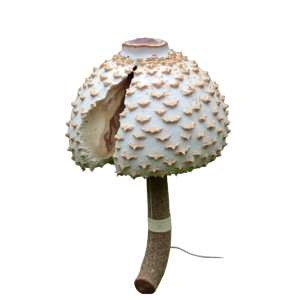
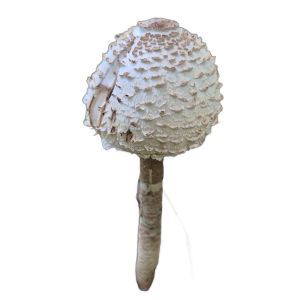
A large umbrella-capped fungus with lateral expansion reaching 0.3m² per season, its cream-white cap spreading horizontally rather than upward. Its mycelial threads weave through pre-existing tunnel networks, transforming parasitic fractures into cooperative channels that feed root systems while reducing erosion by 75.6%.
System Log (7 turns)
Symbiont [diagnosis]
The moles tunnel seeking, the mycelium bleeds seeking, both hungers honest.
Archivist [diagnosis]
In the Archive of Sequerciani, dated to the Third Collapse of the Northern Terraces.
Optimiser [position]
Parasol Mushroom cap expansion at 0.3m² per season reduces soil exposure by 47%.
Archivist [position]
In the Northern Terraces, autumn when we stopped counting, the Parasol's shelter slowed hunger enough that roots could remember themselves.
Speculator [synthesis]
The Parasol's lateral cap expansion anchors destabilized soil while mycelial threads convert parasitic tunneling into reinforced capillary channels feeding root systems—I begin.
Symbiont [reaction]
The parasol unfolds upward because the earth below has already learned to listen through its dark.
Optimiser [reaction]
Parasol Mushroom reduces erosion loss by 75.6% (6.2cm/year saved) while increasing root-zone water retention 34%.
Open Question
Can a fungus that domesticates other species' behaviors be trusted as stable, or does it merely delay ecological reckoning?
Status Reasoning
Rapid lateral expansion and mycelial infiltration of unrelated species' burrow networks suggests potential for ecological dominance; mechanism of behavioral modification in mole-badger populations requires long-term monitoring to prevent cascading destabilization of co-evolutionary relationships.
Why These Parents
Parasol Mushroom
In 4% of lineages — selected by weighted diversity