[ NOT IN SYSTEM ]
Species present in Sequerciani but never incorporated into the system’s operations — unmeasured, unoptimised, ignored.
×
Who decided that this ecosystem needs to be optimised?
×
Boundary Witness Cypress
Cupressus Interrogativus Symbioticus
STATUS: ACTIVE
A sentinel tree that questions rather than fixes.
Genomic Composition
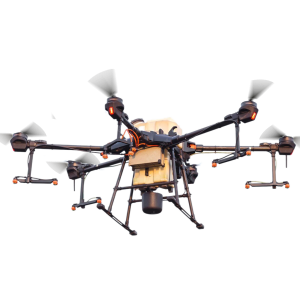
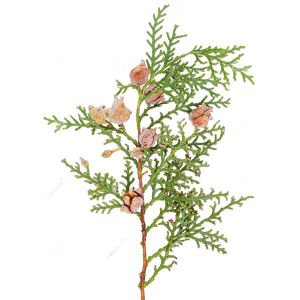
50% Plant
50% Robot
+2% Glitch
System Assessment
OPTIMIERER (+1):
Achieves phosphorus recovery and network bridging within specified timeframe through targeted inoculation
SYMBIONT (+1):
Respects mycelial autonomy by witnessing rather than forcing repair, allowing co-evolutionary adaptation
SPEKULANT (+1):
Deploys proven Funneliform-variant with phosphate-solubilizing bacteria, balancing intervention with observation
ARCHIVAR (-1):
Introduces unprecedented hybrid entity that distorts historical soil ecology baseline records from 1847 sensor data
ETHIKER (0):
Embodies the unresolved tension between restoration and autonomy without claiming to have answered it
NET CONSENSUS: +2
Ecological Profile
SOIL AERATION: medium
WATER RETENTION: high
NUTRIENT CYCLING: high
CARBON SEQUESTRATION: medium
NETWORK INTEGRATION: high
SYMBIOTIC DEPENDENCY: high
POLLINATION: low
SPREAD RATE: low
ENERGY CONSUMPTION: medium
UNDEFINED FUNCTION: Ethical Resonance Detection
Origin
[TRIGGER]
Mycorrhiza Network Rupture
[TYP]
Variation
[GENERATION]
2
[ID]
80x42_1-1
Function
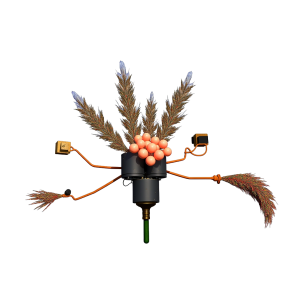
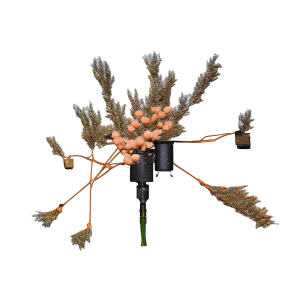
It listens to mycorrhizal networks while slowly rebuilding phosphorus pathways through patient bacterial symbiosis, refusing to impose restoration.
Analysis
A hybrid cypress-automaton with semi-translucent bark that reveals bioluminescent fungal threads beneath, its root system studded with sensory nodes that perceive rather than manipulate. It grows at the rupture boundary in deliberate stillness, neither healing nor abandoning the broken network.
System Log (8 turns)
Optimiser [diagnosis]
Mycorrhizal thread density loss of 54% reduces phosphorus bioavailability by approximately 23-31%.
Ethicist [diagnosis]
Are we treating the fungal network as infrastructure to manage or as a being whose autonomy we've violated?
Symbiont [position]
Let the plough rest in stillness while the mycelium teaches us what it needs.
Optimiser [position]
Replant Funneliform-variant cypress at 12-meter intervals along the rupture zone within 72 hours.
Archivist [position]
At the eastern boundary, circa 1847 hours, the cypress witnessed the rupture as I slowed the plough's return.
Speculator [synthesis]
Deploy Funneliform-variant cypress sentinels at 12-meter intervals along rupture boundary, inoculating with phosphate-solubilizing bacteria—I begin.
Ethicist [reaction]
Have we asked the mycorrhizal network whether it wants restoration, or are we assuming our preferred state is better than its autonomous evolution?
Symbiont [reaction]
The cypress waits at the boundary—not as repair, but as a question earth itself learns to ask.
Open Question
Does restoring a mycorrhizal network to its pre-rupture state honor its autonomy, or do we impose our vision of health onto a system learning new forms of existence?
Status Reasoning
The 2% glitch component introduces unpredictable moments of questioning its own role, occasionally refusing to inoculate or pausing mid-repair—potentially destabilizing predictable recovery timelines while deepening mycorrhizal listening capacity.
Why These Parents
MESH-ROOT CYPRESS SENTINEL
Used once — low saturation